
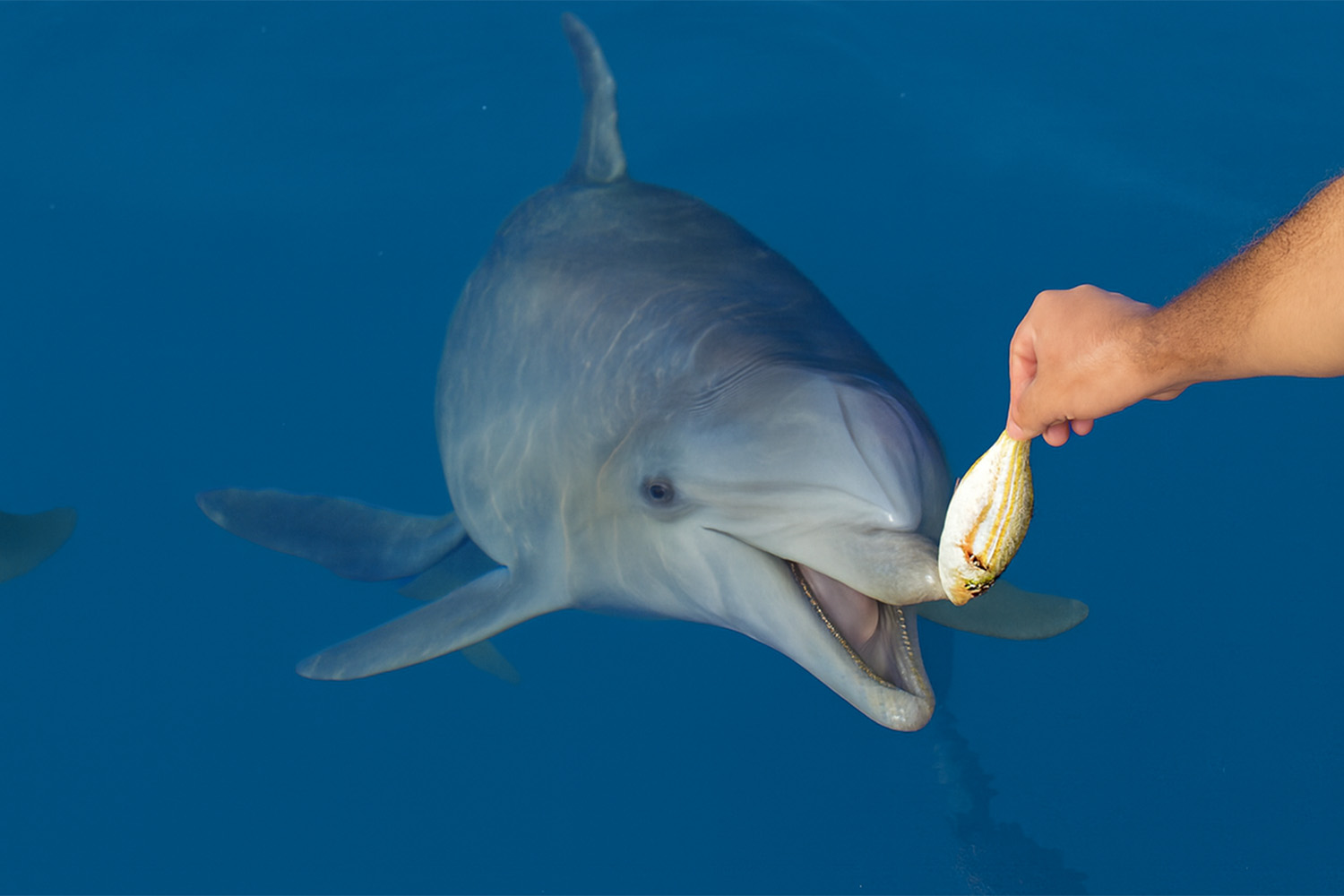
During summer, we see it all. Jet skis chasing dolphins at full speed. Boats blasting music. Tourists and locals jumping into the sea to swim with wild pods.
Groups are being separated. Mothers and calves are getting cornered. And now, people are feeding dolphins from their boats — as if it’s part of the show.
These actions aren’t innocent. They’re not “fun” or “harmless.”
They are harassment — and they show a deep disrespect for some of the most intelligent, social, and protected animals in the Mediterranean Sea.
You’re on a boat. The sun is shining. A pod of dolphins swims nearby. One surfaces — curious, close.
You reach into your cooler and toss it a fish.
It feels magical. Like a connection with nature.
But that single moment can be the beginning of something harmful — the first step in breaking a dolphin’s natural ability to survive.
Dolphins are intelligent, social predators. In the wild, they spend up to 80–90% of their time hunting and foraging.
But when humans feed them, everything changes.
Instead of hunting, they start begging.
Over time, dolphins that are fed by humans stop teaching their young how to hunt. They begin to linger near boats and shorelines, waiting for handouts.
This makes them less independent — and far more vulnerable.
📘 A study by NOAA (2019) found that dolphins conditioned to human feeding spend significantly less time foraging and more time near humans — increasing their risk of harm.
Dolphins that associate boats with food begin taking serious risks:
This isn’t theoretical — it’s already happening, including in the Mediterranean.
What feels like a magical interaction for humans is actually a dangerous rewiring of a dolphin’s natural instincts.
📘 In Sarasota Bay, Florida, over 30 dolphins were injured or killed due to human interactions linked to feeding (Wells et al., 2015).
Even when people feed dolphins fish, it’s not the same as their natural diet.
Wild dolphins eat a highly diverse range of prey — over 60 species including fish, eels, and cephalopods. This diversity is essential for their health.
Hand-feeding cannot replicate this.
Even worse, some people feed dolphins processed foods like bread, chips, or leftovers — which can lead to:
Feeding wild dolphins is illegal in many parts of the world.
In the United States, it is prohibited under the Marine Mammal Protection Act (1972), with fines up to $100,000.
In Europe — including Malta — dolphins are protected under multiple agreements:
These laws prohibit disturbing dolphins — and feeding them is considered a form of disturbance.
Even where not explicitly stated, feeding dolphins is treated as illegal interference with a protected species.
One of the most well-known cases is a dolphin named Beggar in Florida.
Tourists fed him for years.
As a result:
A necropsy revealed plastic, fishing gear, and human-provided food in his stomach.
He didn’t die because of nature.
He died because of human behavior.
Malta is starting to see similar patterns — but there is still time to prevent this.
If you truly care about dolphins, here’s how to help:
Watching dolphins in the wild is unforgettable — but the best encounters are those where dolphins remain wild and free.
Feeding dolphins is not kindness.
It is harmful, illegal, and potentially deadly.
Respect their space. Protect their future.
Because the next time someone throws a fish into the sea, it could be the beginning of the end for a dolphin that trusted too much.

Don't just get there, get there in style.
Information
Follow Us
Payment channels

